

Modified Date
For Executive Assistants (EAs) and event planners, corporate transport is far more than just moving people from one venue to another; it is a critical logistical pillar that can make or break a well-organised event.
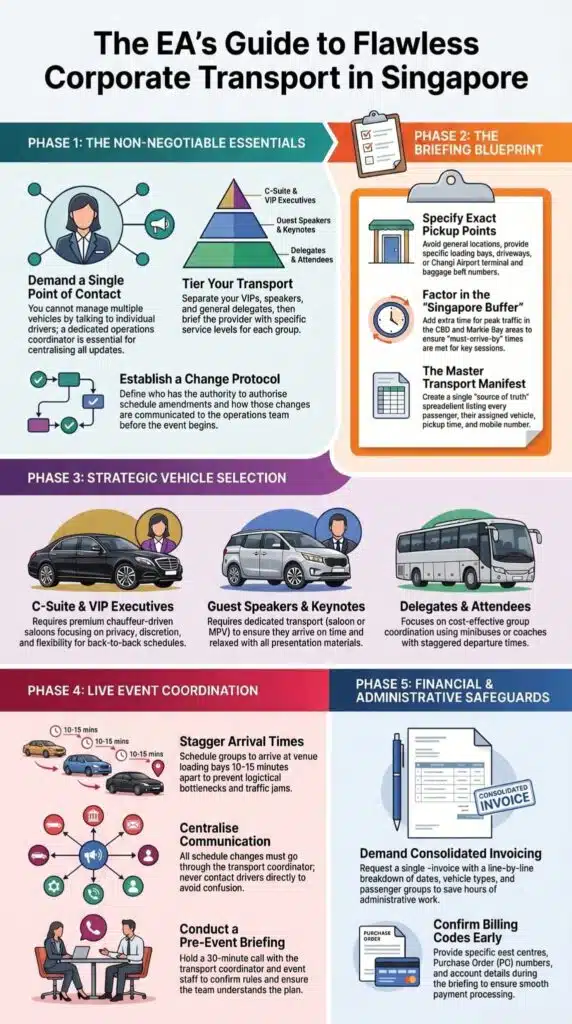
In this guide, we will cover the 5 phases, including: The non-negotiable planning essentials, Briefing blueprint, vehicle selection, Vehicle coordination, as well as corporate financing
Summary
Phase 1: The Non-Negotiable Planning Essentials
Before diving into the details, anchor your approach in these non-negotiable principles.
- Brief with Accuracy: Ambiguity is your biggest enemy. More detail up front means fewer problems on the day.
- Demand a Single Point of Contact: You cannot manage multiple vehicles by talking to individual drivers. A dedicated operations coordinator is essential.
- Tier Your Transport: Corporate passengers have different logistical priorities, including passenger and luggage counts. Segmenting your manifest into different tiers, such as VIP, staff, or general delegates, helps us determine the appropriate vehicles and service levels for each group.
- Plan for Changes: Last-minute schedule changes are inevitable and may require adjustments to existing transportation arrangements, resulting in additional charges. It is best to define who holds change authority.
- Understand the Billing System: Prevent post-event administrative friction by confirming invoicing workflows and corporate approval steps during the initial onboarding phase.
Phase 2: Pre-Booking Strategy & Data Requirements for Corporate Ground Transportation in Singapore

Good corporate transport booking is about gathering information in an organised way.
Start by mapping every critical touchpoint for your delegates, including airport transfers, venue shuttles, the dinner location, and final departures.
Corporate event transportation providers, such as MySingaporeDriver, understand the difficulties that EAs face when organising and gathering their passenger details, and we work closely with them to ensure the right vehicle and pickup are provided.
The Pre-Booking Data Checklist
- The Full Event Schedule: Map out all locations and the specified timings for your itinerary. You can estimate travel times using Google Maps. If unsure, you can always check with your service provider on the estimated travel times and amend the itinerary accordingly.
- Accurate Passenger Manifests: Names, number of passengers and luggage, and clear groupings (such as CEO, Speaker, Delegate).
- Pickup and drop-off points must be exact: Best is to specify the exact location name and postal code. For Changi Airport Terminal, we will follow the flight details accordingly.
- Vehicle Requirements by Segment: Matching vehicle size and type with passenger status and the amount of luggage they have.
- Corporate Billing Arrangements: Ensuring the provider’s bills align with your company’s financial rules.
- The Schedule Change Protocol: Agreeing on how last-minute changes will be communicated and dealt with.
What Should EAs and Event Planners Include in the First Briefing?
Credits: VFairs
For services that handle corporate event transport and multi-vehicle coordination, this document is what their team uses to build your plan. Use the template below as your checklist. Copy it, fill it in, and send it to potential providers to test their speed and attention to detail.
The Corporate Transport Brief (With Template)
Event Core Details:
- Event Name & Dates:
- Booker Name, Role, Mobile & Email:
- Designated On-Site/Event Day Contact Person & Mobile:
Passenger Information (Attach Full Manifest):
- Total Number of Passengers:
- VIP Passengers (Names, Titles, Mobile):
- Speaker/Key Guest Passengers:
- Delegate/General Attendee Groups:
- Special Requirements (Accessibility, Language Preferences):
Flight & Hotel Logistics:
- Inbound Flight Details (Airline, Flight Number, Arrival Time & Terminal):
- Hotel(s) for Transfers (Name, Address, Pickup Point):
- Outbound Flight Details for Departure Transfers:
Movement Schedule:
- Day 1: Airport to Hotel Transfer Times & Vehicle Requirements, including any special considerations that may affect the airport transfer schedule, luggage handling, or passenger grouping.
- Day 2: Hotel to Venue Transfer Times (Morning), Venue to Dinner Transfer (Evening), Dinner to Hotel Return.
- [Repeat for each day]
- Critical: Include must-arrive-by times for key sessions.
Vehicle & Service Specifications:
- Vehicle Tier Required for VIP Movements (e.g., Premium Sedan/Executive Car):
- Vehicle Tier for Group/Delegate Movements (e.g., MPV, Minibus):
- Luggage Volume & Special Equipment (e.g., display materials):
Financial & Administrative:
- Purchase Order Number (if required):
- Invoice Recipient Details (Name, Email, Company Address):
- Preferred Payment Method (Corporate Invoice/Bank Transfer):
Operational Protocols:
- Schedule Change Authority: Who can authorise changes? Provide names and mobile numbers.
Phase 3: How Do You Choose the Right Vehicle Tier for VIPs and Delegates?

Vehicle selection is a strategic choice that balances rules, practicality, and image, particularly when choosing an corporate car solution that reflects the standards expected from a professional corporate car service. The wrong choice can cause logistical problems or break corporate rules.
A tiered approach is standard for managing groups. This isn’t just about luxury; it’s about using the right tool for each passenger’s needs and role.
| Passenger Tier | Core Priorities | Recommended Vehicle Models | Operational Scope & Service Level |
| C-Suite & VIP Executives | • Absolute privacy• Tight, back-to-back schedules• In-transit workspace security | • First-Class Sedan: Mercedes-Benz S-Class• Luxury MPV: Lexus LM | • 100% schedule flexibility for unscheduled stops.• Chauffeur signed to strict non-disclosure protocols. |
| Guest Speakers & Keynotes | • Punctuality• Presentation material capacity• Point-to-point reliability | • Executive Sedan: Mercedes-Benz E-Class• Executive MPV: Toyota Alphard | • Dedicated vehicle assigned for the entire event duration.• Pre-vetted routing to avoid CBD peak restrictions.• Direct coordinator tracking. |
| Delegates & Attendees | • Group coordination• Multi-passenger efficiency• Budget optimization | • Minibus: 13-Seater / 23-Seater Combi• Coach: 40 to 45-Seater Tour Bus | • Staggered, scheduled “waves” departing from designated hotels.• Requires a master transport manifest shared with dispatch.• Clear digital signage on vehicles. |
Phase 4: How Can You Manage Multi-Vehicle Transport for Corporate Events?
The complexity multiplies with each added vehicle. The key is to move from managing cars to managing groups. Your provider’s operations team should work as an extension of your own, handling the live coordination so you don’t have to.
For a service which specialises in multi-vehicle arrangements, this is their main job. They synchronise pickups, monitor traffic, and communicate with all drivers from a single central point.
How Do You Coordinate Multiple Vehicles?
| Best Practice | Description |
| Group by Function and Hotel | Create transport “waves” based on where delegates are staying and when sessions start. One minibus collected from a single hotel is much easier to manage than many cars from different places. |
| Stagger Arrival Times | Do not have all delegates arrive at the venue loading bay at the same time. Schedule groups to arrive 10-15 minutes apart to prevent traffic jams. |
| Create a Master Transport Manifest | Use a shared spreadsheet with your provider to list every passenger, their assigned vehicle/wave, pickup time, and driver contact. This is your single source of truth. |
| Centralise All Communication | All schedule changes must go from you to your one contact at the transport company. They then update all affected drivers. Never contact drivers directly. |
| Conduct a Pre-Event Briefing Call | Have a 30-minute call with your transport coordinator and key event staff to review the schedule, confirm the rules, and ensure everyone understands the plan. |
Phase 5: What Should Corporate Invoicing Include?
Corporate invoicing is an administrative safeguard. A clear, single invoice saves your finance team hours of work. When looking at a provider, ask about their corporate account services.
MySingaporeDriver, for example, offers corporate billing and invoicing, subject to approval, for this job. The invoice should give a clear, line-by-line breakdown that matches your original plan.
What Do You Need for Smooth Billing?
Information You Must Provide:
- Company Legal Name & Address for Invoice.
- Specific Cost Centre or Project Code.
- Purchase Order Number (if your policy requires it).
- Accounts Payable Contact Name & Email.
Why Does a Single Point of Contact Matter for Event Transport?
Managing complex event transport is not done by calling individual drivers. For movements involving multiple vehicles, operational success relies on a synchronised dual-coordinator system.
The Client-Side Lead Coordinator (On-Site): For larger groups, the event marshall or coordinator serves as the main point of contact. They stay with the passenger groups to manage real-time itinerary shifts and passenger needs.
The Transport Command Centre Coordinator: MySingaporedriver provides a dedicated operations coordinator who takes transport instructions from your lead coordinator and executes them across the fleet.
FAQ
How can I coordinate transport for international business events in Singapore?
You can start by collecting the flight details and passenger details as well as mapping out the itinerary.
For high-stakes events, reviewing our guide on Corporate Transport Planning for Trade Shows and Conferences in Singapore ensures you avoid common venue bottlenecks.
How can I manage transport between multiple event locations?
Transport between venues requires careful planning and realistic travel times.
Consider traffic conditions between the Central Business District, event venues, hotels, and recreational spaces.
If unsure, check with your local provider for an estimated travel time and add more buffer time if required.
What local factors can affect corporate transport schedules?
Several local factors can affect travel times, including road works, major exhibitions, public events, and traffic accidents. Event planners should monitor updates from the Land Transport Authority and the Ministry of Transport leading up to the event.
Reviewing transportation plans and local traffic advisories can help reduce delays and avoid last-minute disruptions.
Making Corporate Transport Simple And Reliable
Good corporate transport starts with good planning. Clear instructions, organised timetables, and the right car for each group help events run smoothly from start to finish. For executive assistants and event organisers, a clear plan reduces stress, prevents delays, and provides a professional experience for every guest.
Ready to simplify the transport logistics? Contact MySingaporeDriver to discuss what you need and get a transport plan tailored to you. It will keep your schedule running smoothly from arrival to departure.
References
- https://www.mendeley.com/catalogue/a0b59155-6afd-3384-ae32-de2fa69ec0be/
- https://iora.nus.edu.sg/wp-content/uploads/2021/02/Limousine-Service-Management-Capacity-Planning-with-Predictive-Analytics-and-Optimization.pdf
Related Articles
- https://mysingaporedriver.com/blog/marina-bay-cruise-centre-transport-and-pickup-guide/
- https://mysingaporedriver.com/blog/singapore-airport-transfer-with-kids/
